
The Dark Room
I recently sacrificed the practicality of our class cloakroom in favour of creating a mystery ‘dark‘ room. One that would be inviting enough to inspire my learners to be intrigued to enter and found out more…
This was an idea that came about organically as I observed that the children would naturally gravitate towards the cloakroom during free play sessions. Health and safety in educational spaces dictates that this far from ideal.
After a few attempts at encouraging the class to move away from the said ‘forbidden’ cloakroom, I came to the realisation that we could use this interest in dark spaces to pique their curiosity.
After clearing it with the powers that be (I am lucky to have a very positive working relationship with my superiors) a vision started to formulate.
What if we gave our learners permission to explore this space?
Working with problem areas
It was a naturally dim area of the learning environment. For some, this could be seen as a disadvantage. But in your working space you have to turn every negative into a workable positive OR. CHANGE. IT.
So…during one non-contact period I did exactly that. I both transformed the space and worked with existing conditions in a way that would excite and inspire the children. Non-contact periods are key to helping any progressive educator to achieve the visions that swim before their eyes as they fail to sleep at night. Stay tuned for future posts on this extremely important topic.
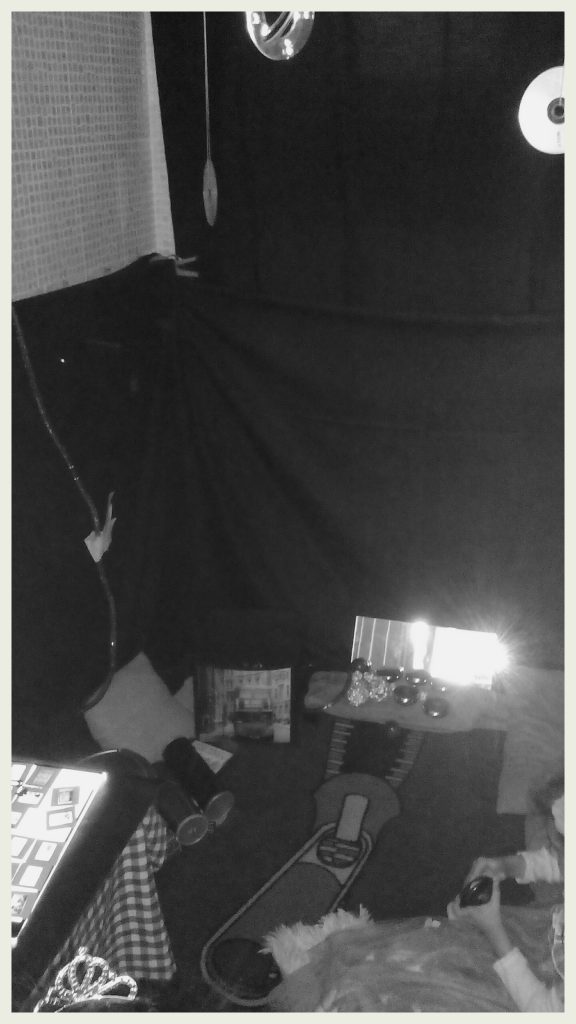
Setting the Scene
Fabric is a game changer every time. I was lucky enough to receive donations of jet black swaths of fabric. I covered every corner of the cloakroom in said fabric. Over-sized towel clips and masking tape were the order of the day.
Despite being a ‘dark room’, some degree of illumination is required to create an invitation to explore and appeal to developing senses. For this, I used LED lighting tubes and an infamous light box as inspired by the Reggio Emillia Early Years approach in Italy. A table projector was set up with slides in the absence of an overhead projector which would provide maximum effect.
Mirrors also allowed the children with the opportunity to view themselves from a different perspective. Above eye level additions include included reflective CD’s and aluminium foil. Ground level curiosity objects such as distorted spy glasses, silver foil balls and hand held silver-cased mirrors were also made accessible.
Relaxation
Lastly, I accepted the fact that some will prefer to use the room as a ‘chill out’ space. With this in mind, I transferred some pillows from our class reading tipee and an additional relaxing element of a CD player with classic stories that the children could operate independently.
The proof is. ALWAYS. in the pudding. I created a sense of anticipation by displaying signage that links to emerging literacy (reading) skills. Meanwhile, lunchtime chats were peppered with the question ‘What could be in the mystery room?’ Cake, Pajama Heroes, Skeletons? (Actual suggestions. The mind boggles).
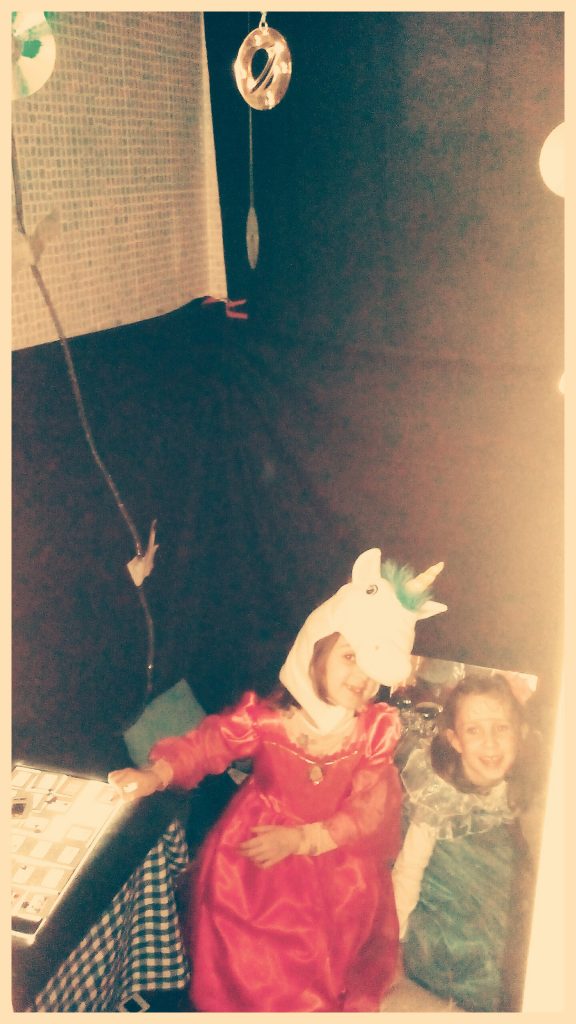
Casual observations
The room has continued to be a sense of wonder this week. The top attraction of the classroom. I can hear quality interaction going on between bilingual pupils of different backgrounds. I can see (through the gap in folding door) meaningful exploration of the objects which will be replaced as observations lead practice.
But, above all, I can feel the happy buzz of excitement in the room which tells me that I fulfilled my brief. My eyes and ears remain tuned in to catch the next…
Is there a space in your classroom? Perhaps a neglected corner that could be better utilised? Where are your learners heading towards at this moment in time and why?
This is a two way exchange. Do you have problem areas in your learning environment? Leave comments below and I’m sure we can discuss some holistic solutions together…
What have you attempted in your ‘problem’ areas?j
Que palabras adecuadas… La idea fenomenal, magnГfica
http://spokupkoy.ru/viewtopic.php?f=22&t=286003
Thanks for your feedback amistala! Think I understood that you liked my idea x